
Freehold vs Leasehold in Ghana: 2026 Comparison
Leasehold vs freehold in Ghana, compared in one table: who may hold each, maximum term, ground rent, renewal and what non-citizens can legally own.
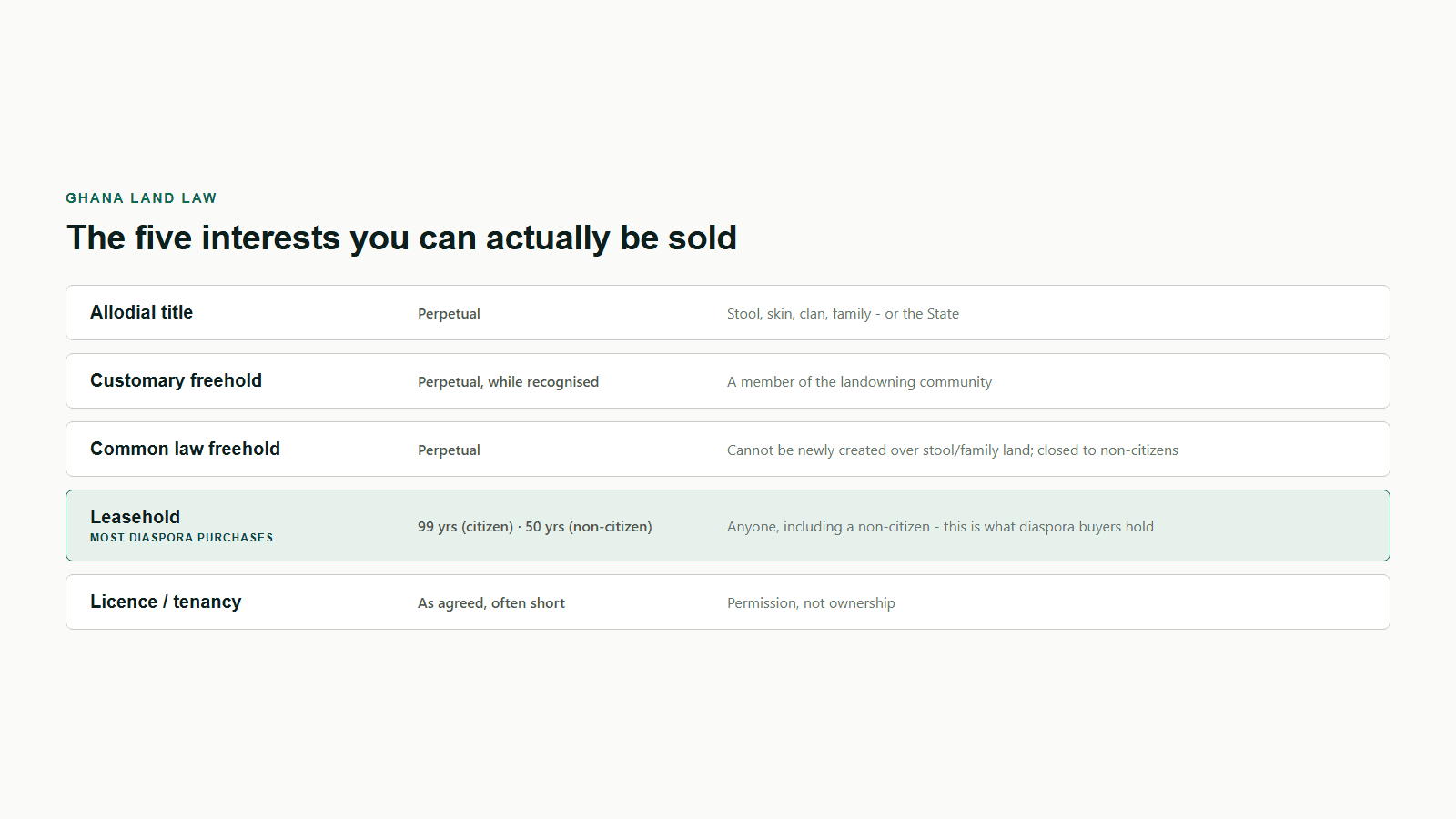
Ghana is functionally a leasehold country. Freehold still exists on paper, but it cannot be created over stool, skin, clan or family land, and no non-citizen may hold it at all. If you are buying in Ghana today, you are almost certainly buying a lease.
That sentence does most of the work, and yet the question keeps being asked, because sellers use both words loosely and some use them interchangeably. This page sets out what each interest actually is, who may legally hold it, what it costs to keep, and what happens when the term runs out.
The five interests you can actually be sold
Ghanaian land law recognises a ladder of interests rather than a binary. An agent saying "it's freehold" may mean any of three quite different things, only one of which will survive a lawyer's reading.
| Interest | Who may hold it | Maximum term | Open to a non-citizen | Ground rent | Passes on death | Usually mortgageable | What happens at the end |
|---|---|---|---|---|---|---|---|
| Allodial title | A stool, skin, clan or family; occasionally the State | Perpetual | No | None - it is the source of ground rent, not a payer of it | Held in trust, not inherited individually | No | Nothing. It does not end. |
| Customary law freehold (usufruct) | A member of the landowning community, by virtue of membership | Perpetual while the interest is recognised | No | Customary obligations rather than a Lands Commission bill | Yes, within the family line | Rarely, and lenders resist it | Nothing, unless it is abandoned or lawfully determined |
| Common law freehold | An individual or company, but it cannot be newly created over stool, skin, clan or family land | Perpetual | No - prohibited by Article 266(1) | None | Yes | Yes, where registered | Nothing. This is why sellers like the word. |
| Leasehold | Anyone, including a non-citizen and a foreign company | 99 years is the common grant to a citizen; 50 years is the ceiling for a non-citizen at any one time | Yes | Yes, annually, for the whole term | Yes, for the unexpired residue of the term | Yes, where registered with a clear unexpired term | Reversion to the grantor unless renewed |
| Licence or customary tenancy | Anyone the grantor permits | As agreed, often short and often oral | Yes | Whatever the arrangement says | Generally not | No | It ends. It is permission, not ownership. |
Read the bottom row twice. A great deal of peri-urban land in Ghana changes hands on documents that create a licence and are described as a sale.
What Article 266 says, and the 50-year cap
Article 266 of the 1992 Constitution is short and it is the provision that governs every diaspora purchase.
No interest in, or right over, any land in Ghana shall be created which vests in a person who is not a citizen of Ghana a freehold interest in any land in Ghana.
— Article 266(1), 1992 Constitution
Two consequences follow. A non-citizen cannot be granted freehold, and a freehold that a non-citizen already held when the Constitution came into force is treated as a leasehold for fifty years. Article 266 also caps any leasehold granted to a non-citizen at fifty years at any one time.
"At any one time" is the phrase people miss. It is not a fifty-year limit on your relationship with the land. It is a limit on the length of a single grant, which is why a properly drafted diaspora lease is written as fifty years renewable rather than fifty years and out.
Dual nationals hold Ghanaian citizenship and are not caught by Article 266. Holders of the Right of Abode are not citizens, and are. That distinction is where we see the most expensive misunderstandings, usually discovered at registration rather than at signing.
What Article 267 does to freehold on stool land
Article 267(5) prohibits the creation of any freehold interest in stool land, however described. The Land Act 2020 extends the same prohibition to skin, clan and family land.
Since a large share of Ghanaian land is held under customary tenure, this removes freehold from most of the market as a matter of law rather than of preference. When somebody offers you freehold on land that the chief's family granted, one of three things is true: they mean a usufruct, they mean a long lease, or they are selling something that cannot exist.
Article 267 also sets up the Office of the Administrator of Stool Lands and the formula by which stool land revenue is split. We cover that, and the annual bill it produces, in how ground rent is billed on a Ghanaian leasehold.
What the Land Act 2020 changed
The Land Act 2020 (Act 1036) consolidated Ghana's land statutes into a single instrument. Four changes matter to a buyer.
- It restates the freehold prohibition and extends it explicitly to skin, clan and family land, closing an argument that used to be run at the margins.
- It restates the fifty-year ceiling on a leasehold granted to a non-citizen.
- Section 12 criminalises land guard activity, including the use of violence to keep a rightful holder off their land and the extortion of money from lawful owners. Whether enforcement matches the drafting is a separate question, but the offence now exists.
- It strengthens spousal rights over land acquired during a marriage, so that an interest acquired jointly cannot be disposed of without the other spouse's consent. If you are buying from an individual, this is a live diligence point.
None of this changes the answer to leasehold or freehold. It changes how carefully you need to read who is granting, and on what authority. We take the document apart clause by clause in what a Ghana land indenture actually contains.
A worked example: a 50-year term against a 99-year on the same plot
Nobody publishes this arithmetic, so here it is, with our assumptions on the table. These are assumptions, not quoted rates. Substitute the figure on your own invoice.
Assume a ground rent of GHS 600 a year on a residential parcel, and assume for a moment that it is never reviewed.
- Over a 50-year term: GHS 30,000, or about USD 2,632 at the Bank of Ghana interbank mid rate of 11.4000 on 4 September 2026.
- Over a 99-year term: GHS 59,400, or about USD 5,211 at the same rate.
Now the honest part. That second assumption is false. Leases carry rent review clauses, typically every five to ten years, and fifty years of Ghanaian inflation makes any un-reviewed projection meaningless. The arithmetic is worth doing anyway, for one reason: it shows that the whole-life ground rent on a residential plot is small next to the purchase price. The cost of a leasehold is not the rent. It is the shortening term.
That is the number to think about instead. Buy a 99-year lease and sell in year ten, and your buyer receives 89 years. Buy a 50-year lease and sell in year ten, and your buyer receives 40, and their lender - if they have one - is looking at a term that will need renewing inside the life of a mortgage. Ghanaian valuation practice discounts short unexpired terms, and we would not put a percentage on it here, because it varies by locality and by lender and we have no dataset we would stand behind.
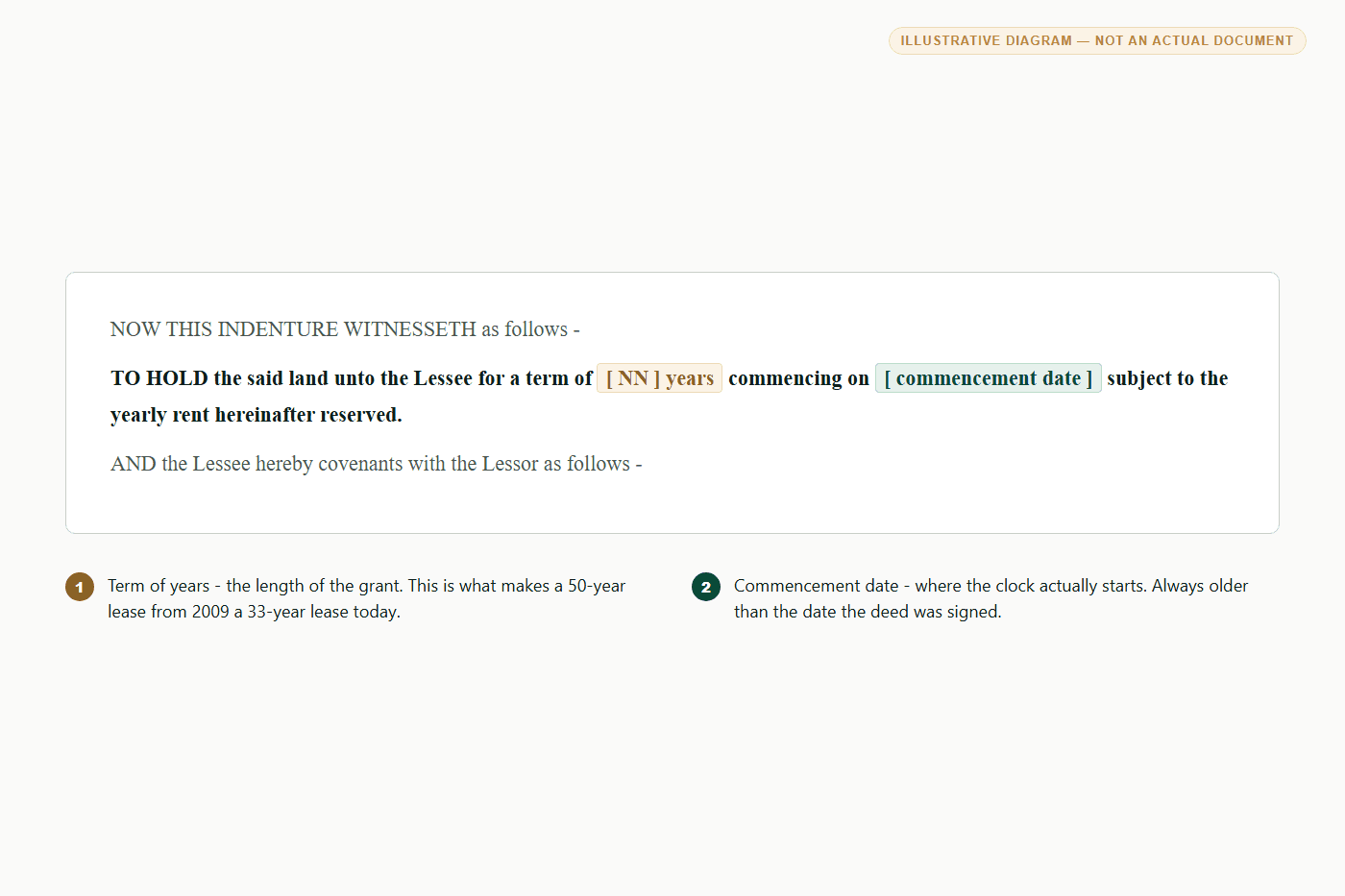
What we would say is this: ask for the commencement date, not just the term. A "50-year lease" granted in 2009 is a 33-year lease today.
The two questions to ask before you sign
First: what is the unexpired term, counted from the commencement date in the habendum, and where does that clause sit in the document? If the seller cannot point to it on the page, the seller has not read the lease either.
Second: what does renewal actually require? A renewable lease should say who may renew, on what notice, and on what basis the new rent is set. A lease that is silent on renewal is not renewable by kindness. Silence is a negotiation you will conduct in forty years' time, from a weak position.
There is a third question that people are shy about, and should not be. Ask for the ground rent receipts, then verify the title independently rather than taking the vendor's copy of the search. The process for doing that is in our guide to verifying a land title at the Lands Commission.
This is also the reason estates built for diaspora buyers are structured the way they are. Our eight-unit gated estate at Akatsi, Volta Region, Ghana is held on a fifty-year renewable leasehold, which is the longest lawful single grant to a non-citizen, with the renewal mechanic written into the lease rather than left to goodwill.
Questions we get asked
Can a foreigner own freehold land in Ghana?
No. Article 266(1) of the 1992 Constitution prohibits the creation of a freehold interest in favour of a non-citizen. The longest interest available is a leasehold of fifty years at any one time, which can be drafted as renewable.
What happens when a 99-year lease expires?
The land reverts to the grantor unless the lease is renewed. In practice renewal is applied for before expiry, on the terms the lease sets out, and a lease with ground rent in arrears is a materially harder renewal.
How do I renew a leasehold in Ghana?
Apply through the grantor and the Lands Commission before the term ends, with the lease, the title documents and evidence that ground rent is current. Start early. This is not an errand to begin in the final year.
Is leasehold land a good investment in Ghana?
It is the normal form of ownership here rather than a compromise, so the question is really about the unexpired term. A long, registered, renewable lease with rent paid behaves much like ownership. A short or unregistered one does not.
What is the difference between leasehold and customary freehold?
A customary law freehold, or usufruct, arises from membership of the landowning community and continues indefinitely. A leasehold is granted for a fixed term to anyone, including a non-citizen, and carries an annual ground rent.
Can I convert a leasehold to a freehold in Ghana?
Not on stool, skin, clan or family land. The creation of a freehold interest over that land is prohibited, so no conversion is available regardless of what any party agrees.
Sources and verification
Legal position and figures verified September 2026.
- 1992 Constitution of Ghana, Articles 266 and 267: https://audit.gov.gh/files/publications/The_1992_Constitution_of_the_Republic_of_Ghana635603143.pdf
- Land Act 2020 (Act 1036), full text: https://landwise-production.s3.amazonaws.com/2022/06/LAND-ACT-2020-ACT-1036.pdf
- Key highlights of Ghana's Land Act 2020, LEX Africa: https://lexafrica.com/2022/04/key-highlights-of-ghanas-land-act-2020/
- Bank of Ghana daily interbank FX rates, USD/GHS mid 11.4000 on 4 September 2026: https://www.bog.gov.gh/treasury-and-the-markets/daily-interbank-fx-rates/
The ground rent arithmetic above uses a stated assumption, not a published rate. There is no national ground rent schedule; amounts are assessed per parcel.
One next step: send us the lease you have been offered and we will tell you which of the five interests above it actually creates. Ask Toivo Investment.