
Cost to Build a House in Volta Region, Ghana (2026)
What it costs to build a house in the Volta Region in 2026: materials, labour, the 20% VAT, fees and the rainy season - in cedis and dollars.
A completed four-bedroom house in Ghana was reported in 2026 to cost between GHS 670,000 and GHS 1.2 million, or roughly USD 58,800 to USD 105,300 at the Bank of Ghana interbank mid rate of 11.4000 on 4 September 2026. In the Volta Region the land component runs well below the Accra equivalent, and the delivered materials cost runs above it.
That is the honest headline. What follows is the breakdown, with a source and a date against every figure, and a plain statement of the numbers we do not have. We build at Akatsi, Volta Region, Ghana, so some of this is our own operating experience and some of it is published data. We have marked which is which.
Land: what a plot costs, and why we will not quote you one
We are not publishing a cedi-per-plot figure for Akatsi or the wider corridor. There is no published land price index for the Volta Region that we could load and cite in September 2026, and the figures circulating on other sites trace back to blog posts rather than to a survey, a valuer or a registry.
What we can tell you is how the price is actually formed, which is more useful when you are negotiating.
- Distance from the trunk road. Frontage on or near the Accra-Aflao road prices differently from land four kilometres behind it, and the gap is larger in the Volta corridor than the equivalent gap in an Accra suburb.
- Whether it is serviced. Access road, power to the boundary, and a water solution. Unserviced land is cheaper for a reason, and the reason costs money later.
- Title status. A registered leasehold with a clean search prices above an allocation paper, and it should. The discount on a weak document is the market pricing your future litigation.
- Who is selling. Family land, stool land through the appropriate authority, and a developer's serviced plot are three different products at three different prices.
To get a real number, ask a licensed valuer for a Volta corridor opinion, and separately ask two or three sellers in the specific town for their asking price on a comparable plot. Do both. The gap between them is the negotiation.
Materials, with sources and dates
The material figures below are national press-reported ranges for 2026, not a survey we conducted. They are the best sourced numbers publicly available at the time of writing, and we have converted each to dollars at a single dated rate.
| Input | Reported figure (GHS) | USD equivalent | Source and date |
|---|---|---|---|
| Cement, per bag | 75 to 101 | 6.60 to 8.90 | YEN.COM.GH cost guide, August 2026 |
| Concrete block, each | about 6.20 | about 0.54 | YEN.COM.GH cost guide, August 2026 |
| Standard residential construction, per square metre (Greater Accra guide) | 4,200 to 5,500 | 368 to 482 | YEN.COM.GH cost guide, August 2026 |
| Completed four-bedroom house | 670,000 to 1,200,000 | 58,800 to 105,300 | YEN.COM.GH cost guide, August 2026 |
| Building cost inflation, year on year | 3.1 per cent (June 2026) | n/a | Ghana Statistical Service, as reported August 2026 |
Three caveats, because a table without caveats is a trap.
First, these are national and Accra-referenced figures. A cement price quoted at an Accra depot is not your delivered price at a Volta site. Haulage is real and it scales with distance from the depot and with the condition of the last few kilometres of road. Budget the delivered price, and get it in writing from the supplier who will actually deliver.
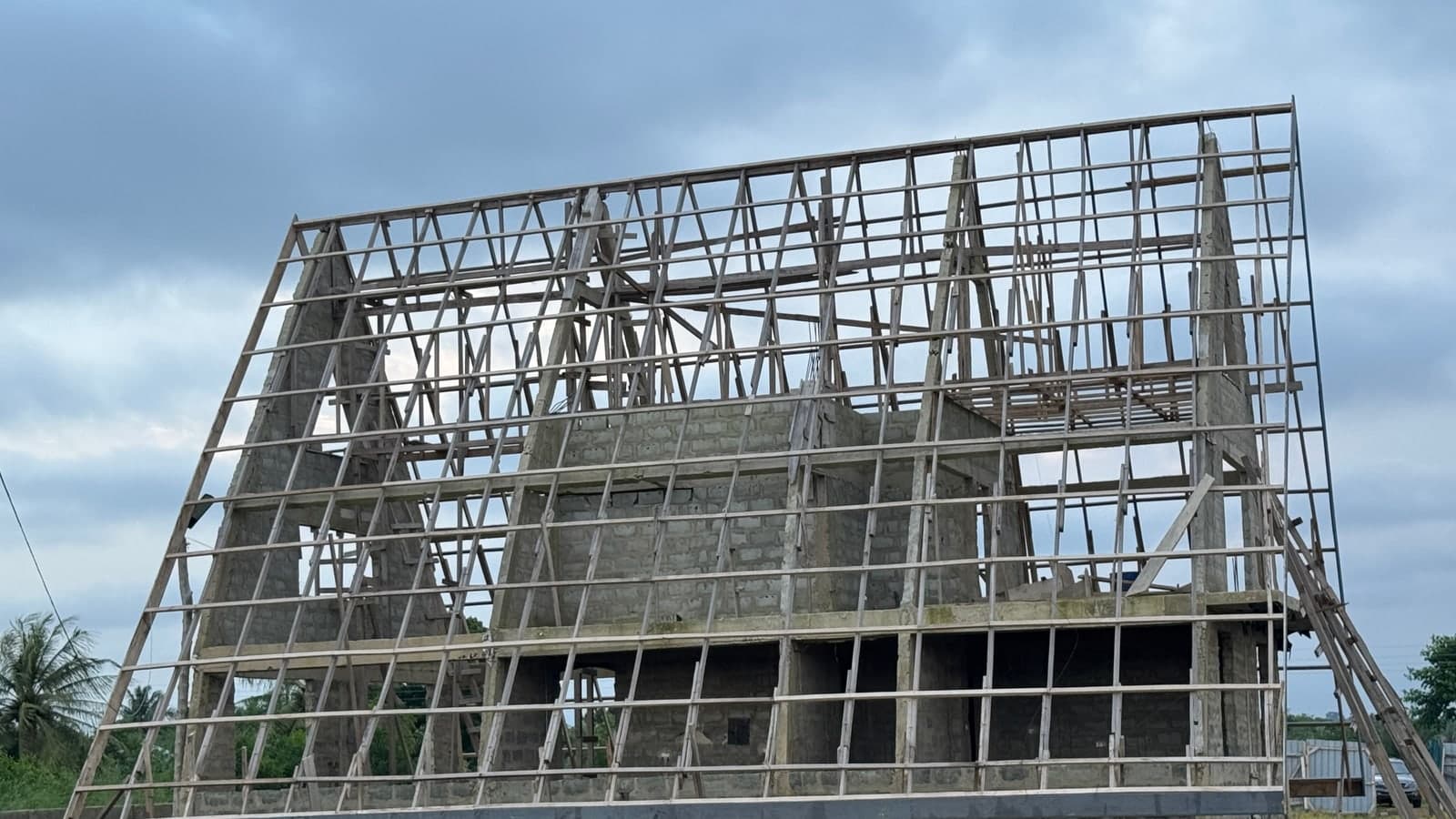
Second, the per-square-metre range is for standard residential construction. It does not describe an A-frame with a steep gable, a glazed end wall, or marble and timber finishes. Geometry and specification move that number a long way, in both directions.
Third, a completed-house range covers a wide spread of finishing standards. The difference between the bottom and the top of GHS 670,000 to GHS 1.2 million is mostly finishes, fittings and how much of the work was supervised properly.
Labour: why Volta rates are lower and the bill is not
Day rates for general trades in the Volta Region run below Accra rates. That is real and it is one of the reasons regional development works economically.
It also does not translate into the saving people expect, for two reasons we have paid for directly.
The first is depth of trade. Masons, carpenters and steel fixers are available locally and competent. Specialist work is thinner — proper waterproofing detail, structural steel fabrication, joinery finished to a standard a diaspora buyer will accept on handover. Those trades are often brought from Ho or Accra, and once you are transporting and housing a crew, the hourly saving is gone.
The second is supervision. Labour is only cheap when it is watched. An unsupervised regional site with an absent owner produces rework, and rework is the most expensive line item in Ghanaian construction because you pay for the same square metre twice. If you are building from abroad, the supervision cost is not optional and it belongs in the budget from day one. We wrote about the wider version of this problem in building a house in Ghana from abroad.
The 20 per cent VAT on housing construction
A 20 per cent VAT applies to housing construction in Ghana, and it sits inside whatever figure a developer or contractor quotes you. It is not a line most quotes break out, and you should ask for it broken out.
The Ghana Real Estate Developers Association renewed its public call for the charge to be scrapped in August 2026, arguing through its president that it is worsening housing affordability. That is an industry position rather than a change in the law, and as of September 2026 the charge is live. If it moves, the arithmetic on every quote in the market moves with it, which is a reason to date any quote you are given.
Financing costs are the other macro line. The Bank of Ghana Monetary Policy Rate stands at 14.00 per cent, held at the July 2026 meeting of the Monetary Policy Committee. If you are borrowing locally to build, that is the floor your lender prices from. The Committee next meets on 22 to 24 September 2026, so confirm the rate before you sign anything after that date.
Fees: permits, survey, Lands Commission, legal
We are not publishing a fee table, and the reason is worth stating clearly because every competing page has one.
Ghanaian land and permit fees are assessed per application. Lands Commission charges depend on the parcel, the service and the region, and the Commission publishes a Bill Calculator on its online services portal for exactly this reason. Municipal building permit fees are set by the Assembly and vary by district and by the size and class of the structure. Survey and legal fees are professional fees, negotiated.
Every cedi fee table we found in circulation in September 2026 traced back to another blog rather than to a schedule published by the body that charges it. We are not reprinting numbers we cannot stand behind.
What to do instead, in order:
- Run the Lands Commission Bill Calculator for your specific parcel and service, screenshot the output, and write the date on it.
- Ask the Akatsi South Municipal Assembly, or the relevant Assembly for your town, for the current building permit fee schedule for your building class. Ask in person or in writing; ask for the schedule, not for a verbal figure.
- Get a written fee quote from a licensed surveyor for the site plan and setting out.
- Get a written fee quote from your lawyer covering the search, the conveyance, stamping and registration.
- Add the four together, and add a contingency you are willing to say out loud.
That takes about a fortnight and produces a budget that belongs to your project rather than to somebody's article.
Timeline, and what the rainy season actually does
The Volta rainy season is not a delay. It is a design constraint, and treating it as a delay is how people end up with foundations poured into saturated ground.
What actually happens: access roads soften and material deliveries become unreliable. Excavations fill. Blockwork laid in persistent wet cures badly. Low-lying parts of the southern Volta flood, and the flooding is recurrent rather than exceptional. Working through it is possible and it is expensive, and the expense shows up two years later as cracking.
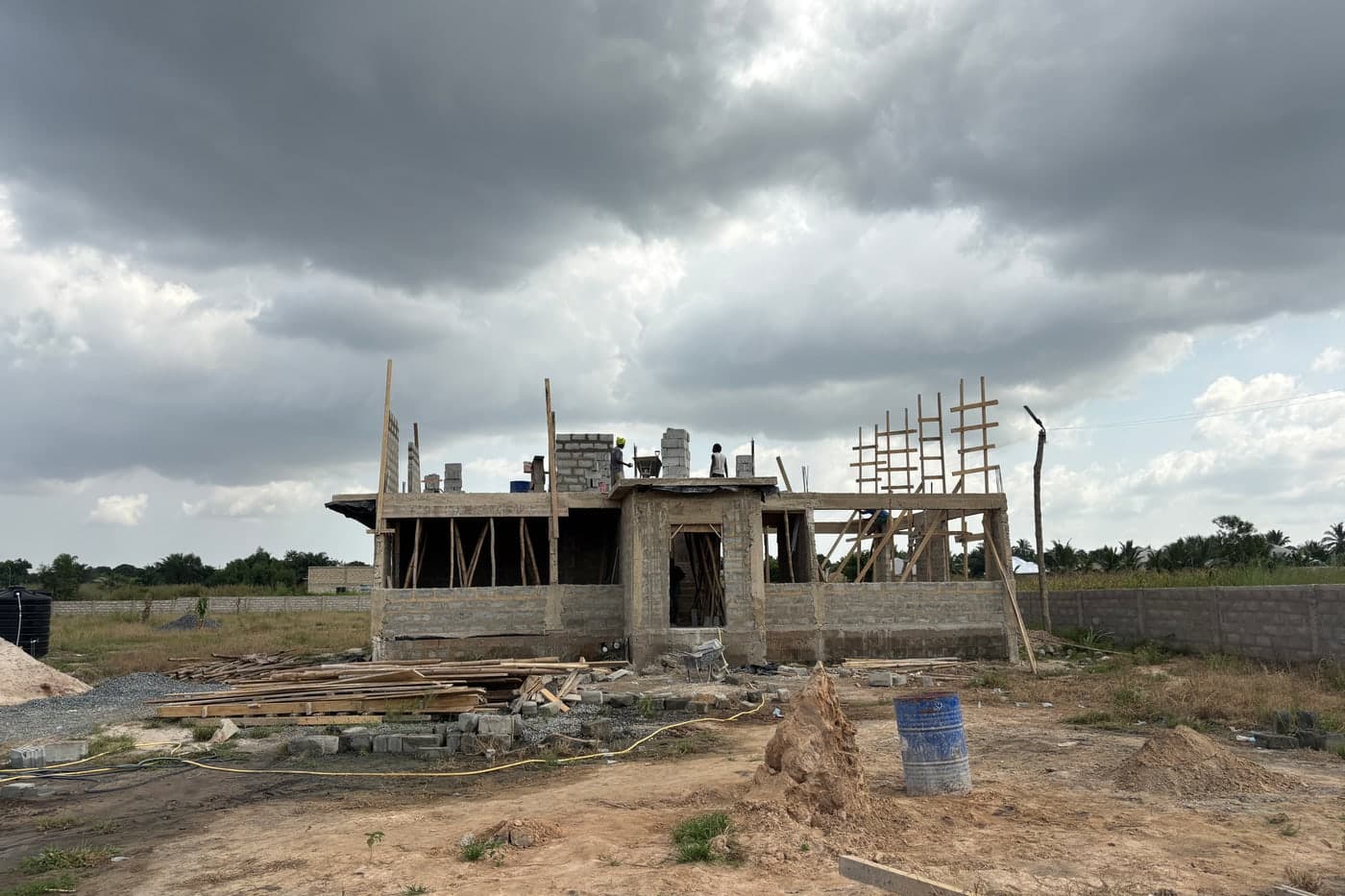
Our own build at Akatsi is around 65 per cent complete and paused for the rainy season, resuming as the ground clears. We describe that as climate discipline rather than as a delay because that is what it is, and because we would rather explain a pause now than a defect later.
We do not publish a delivery date. We publish progress instead, and let the stage-percentage speak for itself. Any contractor who commits to a fixed completion date across a Volta wet season without a weather clause is telling you something about how they intend to handle the weather.
Build or buy into a finished estate
The comparison people run is build cost against purchase price, and that comparison is incomplete.
| Consideration | Self-build | Buying into an estate |
|---|---|---|
| Headline cost | Usually lower per square metre | Higher per square metre, includes shared infrastructure |
| Land risk | Yours, entirely | Carried by the developer, verifiable before you pay |
| Supervision | You pay for it, in money or in flights | Included |
| Shared infrastructure | Gate, road, drainage, power, water - all yours to fund | Spread across the units |
| Cost certainty | Exposed to material inflation across the build period | Fixed at the point of agreement |
| Rework risk | High without on-site supervision | Developer's problem before handover |
| Timeline control | Yours | Not yours |
| Ongoing service charge | None, but you carry every service yourself | Yes, and it covers the gate, grounds and shared systems |
Self-build wins on headline cost and loses on almost everything that is hard to see from four thousand miles away. That is not a pitch, it is arithmetic about attention. If you can be in Ghana regularly, or you have a relative you would trust with a bank card, self-build is a reasonable route and the saving is genuine.
If you cannot, the supervision line will either be paid or it will be paid later at a higher rate. Our eight-unit gated estate at Akatsi, Volta Region, Ghana exists because we took that view about a specific corridor and put our own capital behind it. Our process, including how buyer money is held against milestones, is on the how it works page. What developers in the region are building more broadly is covered in our guide to estate developers in the Volta Region.
Questions we get asked
How much does it cost to build a house in the Volta Region in 2026?
Published Ghanaian figures for 2026 put a completed four-bedroom house at GHS 670,000 to GHS 1.2 million nationally. In the Volta Region expect a lower land cost and a higher delivered materials cost, and price both locally rather than from a national average.
Is it cheaper to build in the Volta Region than in Accra?
Land is substantially cheaper. Construction is not proportionally cheaper, because materials travel further and specialist trades are often brought in from Ho or Accra.
How much is a plot of land in Akatsi?
We do not publish a figure, because no verifiable Volta land price index exists. Ask a licensed valuer for a corridor opinion and get asking prices from two or three sellers on comparable plots in the specific town.
Does VAT apply to building a house in Ghana?
A 20 per cent VAT applies to housing construction and is normally embedded in the quoted price. Ask for it broken out. GREDA renewed its call for the charge to be scrapped in August 2026; as of September 2026 it remains in force.
How long does a Volta Region build take?
Longer than the equivalent Accra build, because the rainy season stops work and material deliveries. Any schedule without a weather allowance is not a schedule.
Should I build or buy into a finished estate?
If you can supervise regularly on the ground, building is usually cheaper. If you are managing from abroad, the supervision and rework risk generally outweighs the per-square-metre saving.
Sources and verification
Figures verified September 2026. We re-check monthly.
- YEN.COM.GH, cost of building a four-bedroom house in Ghana in 2026, August 2026: https://yen.com.gh/real-estate/309764-how-costs-build-a-decent-4-bedroom-house-ghana-2026/
- Bank of Ghana daily interbank FX rates, USD/GHS mid 11.4000 on 4 September 2026: https://www.bog.gov.gh/treasury-and-the-markets/daily-interbank-fx-rates/
- Bank of Ghana policy rate trends, Monetary Policy Rate 14.00 per cent, held at the July 2026 MPC: https://www.bog.gov.gh/monetary-policy/policy-rate-trends/
- Graphic Online, GREDA on the 20 per cent VAT and housing affordability, August 2026: https://www.graphic.com.gh/news/general-news/ghana-news-20-vat-worsening-housing-affordability-greda.html
- Adom Online, GREDA renews call for scrapping of 20 per cent VAT on housing: https://www.adomonline.com/greda-renews-call-for-scrapping-of-20-vat-on-housing/
- Lands Commission online services portal and Bill Calculator: https://onlineservices.lc.gov.gh/
Material prices and the completed-house range on this page are press-reported national figures, attributed above, not a survey conducted by Toivo Investment. The Ghana Statistical Service building cost inflation figure is cited as reported in August 2026 and is pending direct confirmation against a Ghana Statistical Service release.
One next step: send us your plot details and specification and we will tell you what it would cost to build it in the Volta corridor, with the figures sourced. Ask Toivo Investment.