
Estate Developers in the Volta Region (2026 Guide)
Estate developers in the Volta Region work under different land, labour and logistics rules than Accra. How to check one is real before you pay.
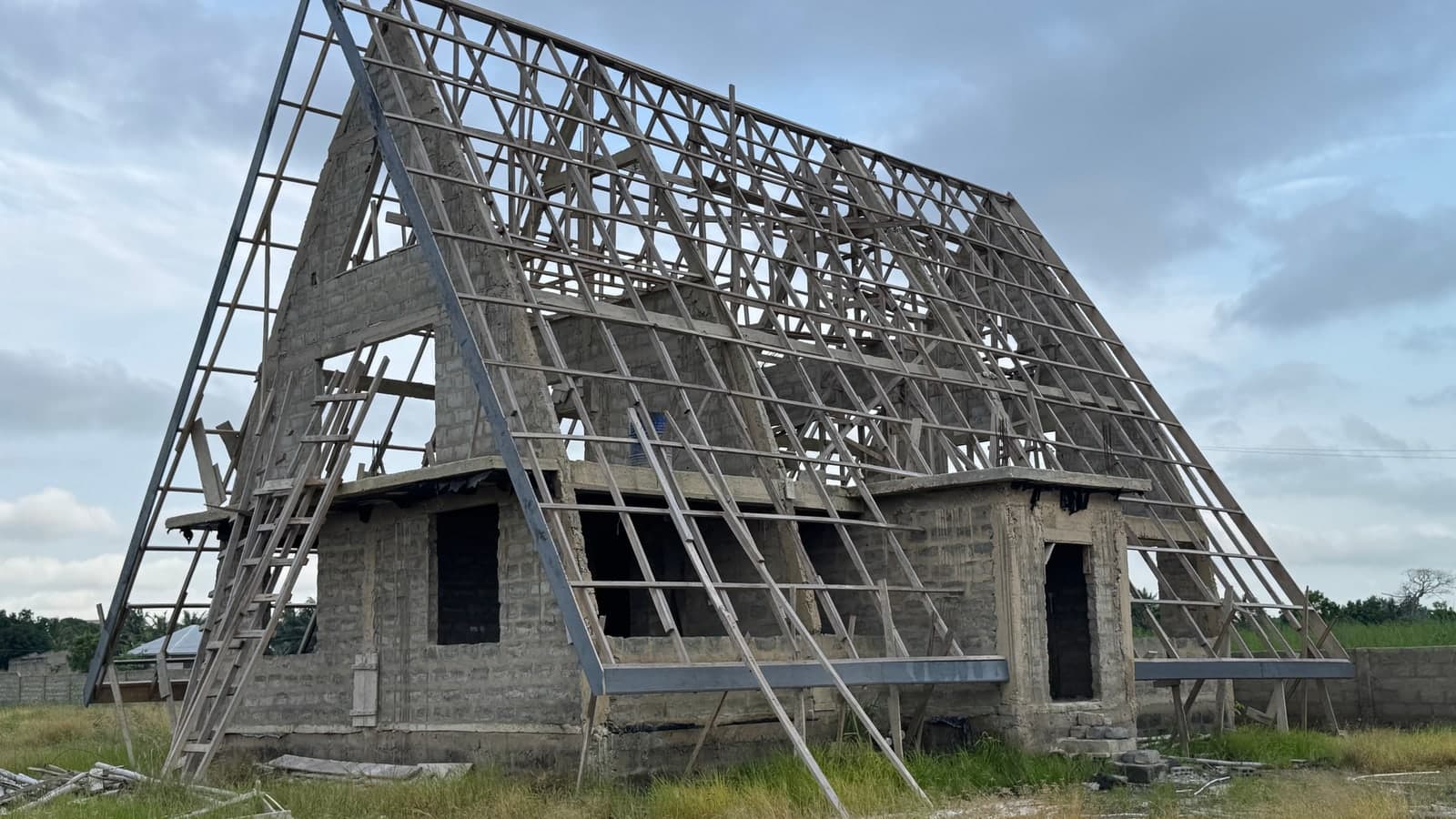
Estate developers in the Volta Region operate under different land, labour and logistics conditions than developers in Greater Accra. Land is cheaper and title chains are often shorter. Skilled trades are thinner on the ground and materials travel further. Both facts show up in the price you are quoted.
We build at Akatsi, Volta Region, Ghana, so we are one of the companies this page is about. That is worth stating at the top rather than burying it. What follows is how the regional development business actually works, what to check before you pay anybody, and what we can and cannot verify about who else is active here.
Why building outside Greater Accra is a different business
Four things change once you leave the Greater Accra land market, and they change in opposite directions, which is why regional pricing confuses people.
Land cost falls, and it falls a long way. A serviced plot in East Legon and a plot on the corridor are not in the same order of magnitude. That is the whole economic case for regional development, and it is why a developer can put a gate, a road and landscaping around a scheme here that would be unaffordable at Accra land prices.
Title chains are often shorter and cleaner. Peri-urban Accra has decades of overlapping grants, multiple claimants to the same allodial title, and a well-developed industry in selling the same plot twice. Rural and small-town Volta land has less transaction history. Less history means fewer competing claims to unpick. It does not mean no risk, and unregistered allocation papers sold as title are common on peri-urban Volta land too.
Skilled labour is thinner. Masons, steel fixers and carpenters are available. Specialist trades — proper waterproofing, structural steel, joinery to a finish standard a diaspora buyer expects — are frequently brought from Accra or Ho and housed. That is a real line in a regional budget and honest developers price it in rather than discovering it in month seven.
Logistics adds cost per bag and per trip. Cement, reinforcement and roofing arrive by road. The Accra ex-works price is not your delivered price, and the gap widens the further you are from the depot.
There is a fifth factor that no spreadsheet holds. The Volta rainy season and recurring flooding in the low-lying south of the region stop work. A developer who plans around that looks slower than one who does not. The one who does not is building on saturated ground.
What is actually being built along the corridor
The activity concentrates in a corridor rather than spreading evenly across the region.
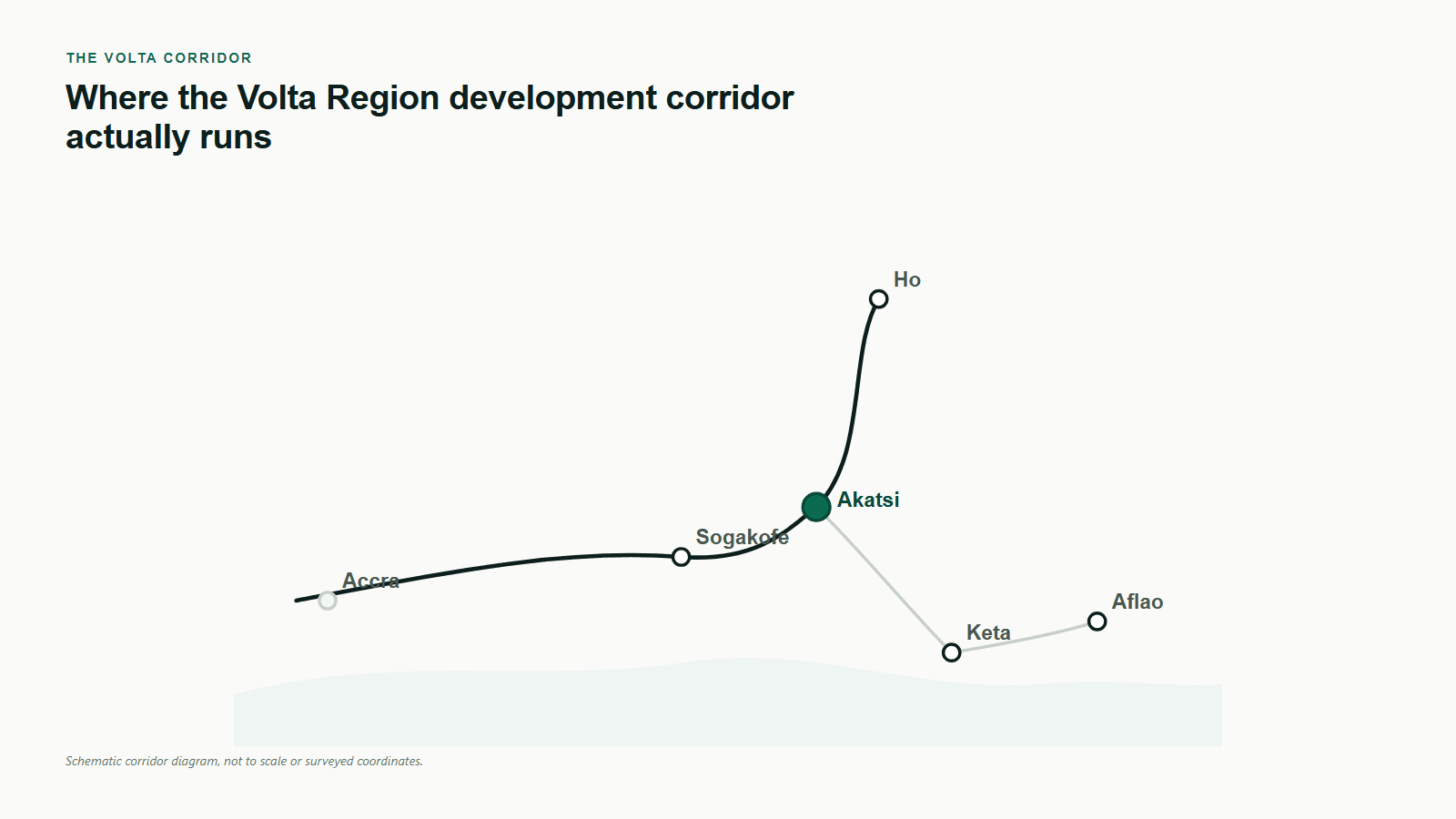
Ho is the regional capital and carries the administrative and university demand — staff housing, rentals, small apartment blocks, and plots sold for self-build.
Akatsi sits on the Accra-Aflao road as the capital of the Akatsi South Municipality. It is a junction town, which is why it is a natural place to build for people who need to reach both Accra and the coast.
Sogakofe and the Volta estuary communities carry the tourism-adjacent demand. This is where lake-fringe and river-frontage land is traded, and where short-let and holiday-home logic starts to make sense rather than pure residential logic.
Keta and the coastal strip carry a mix of returnee housing and hospitality, tempered by coastal erosion and sea defence considerations that a buyer should ask about explicitly.
Formal inventory across all of it is thin. Ghana Property Centre, one of the larger national portals, listed 24 properties for sale in the entire Volta Region when we checked in September 2026. Compare that with the volume the same portal carries for a single Accra suburb. Thin listings do not mean nothing is happening. They mean most of what happens here happens off-portal, through families, chiefs and direct developer sales, which is precisely why verification matters more here than it does in Accra.
How to check a developer is real
The checks below work anywhere in Ghana. They matter more in a region with less public transaction record.
- Registrar-General search. Every legitimate Ghanaian company is registered. The search tells you incorporation date, current directors and whether annual returns are filed. Three years of overdue returns is an answer.
- GIPC registration, if money is coming from abroad. GIPC registration is what allows a firm to lawfully receive foreign currency for client work and to repatriate proceeds on a resale. Toivo Investment has been GIPC-registered since 2019.
- GREDA membership. The Ghana Real Estate Developers Association is a trade body. Membership is a signal about a firm's standing among peers and its willingness to be findable. It is not a licence and it is not a guarantee, and you should treat anyone who presents it as regulatory approval with care.
- Developer or agent. A developer selling its own project acts as principal. A firm marketing or broking property on behalf of others is an agent and is required to hold a Real Estate Agency Council licence under the Real Estate Agency Act 2020. Establish which one you are dealing with, then ask for the licence only from the one that needs it. Toivo Investment is a principal developer and sells its own projects.
- Who holds your money. Payment into an independent escrow arrangement, with defined release milestones, is a different risk profile from wiring a deposit into a developer's operating account. Ask the question before the enthusiasm phase ends.
- Site visit rights, in writing. Not "you're welcome to visit". A clause. Whoever you send should be able to walk the boundary and photograph it without notice periods that allow a site to be dressed.
We run a longer version of this before we transact with anyone, and it is written up in the eight checks we run before paying any developer in Ghana.
Who is developing in the Volta Region
We are not going to publish a ranked list, because we are one of the companies on it and because scoring competitors from inside the market is not information, it is marketing.
What we can do is tell you what is verifiable and what is not.
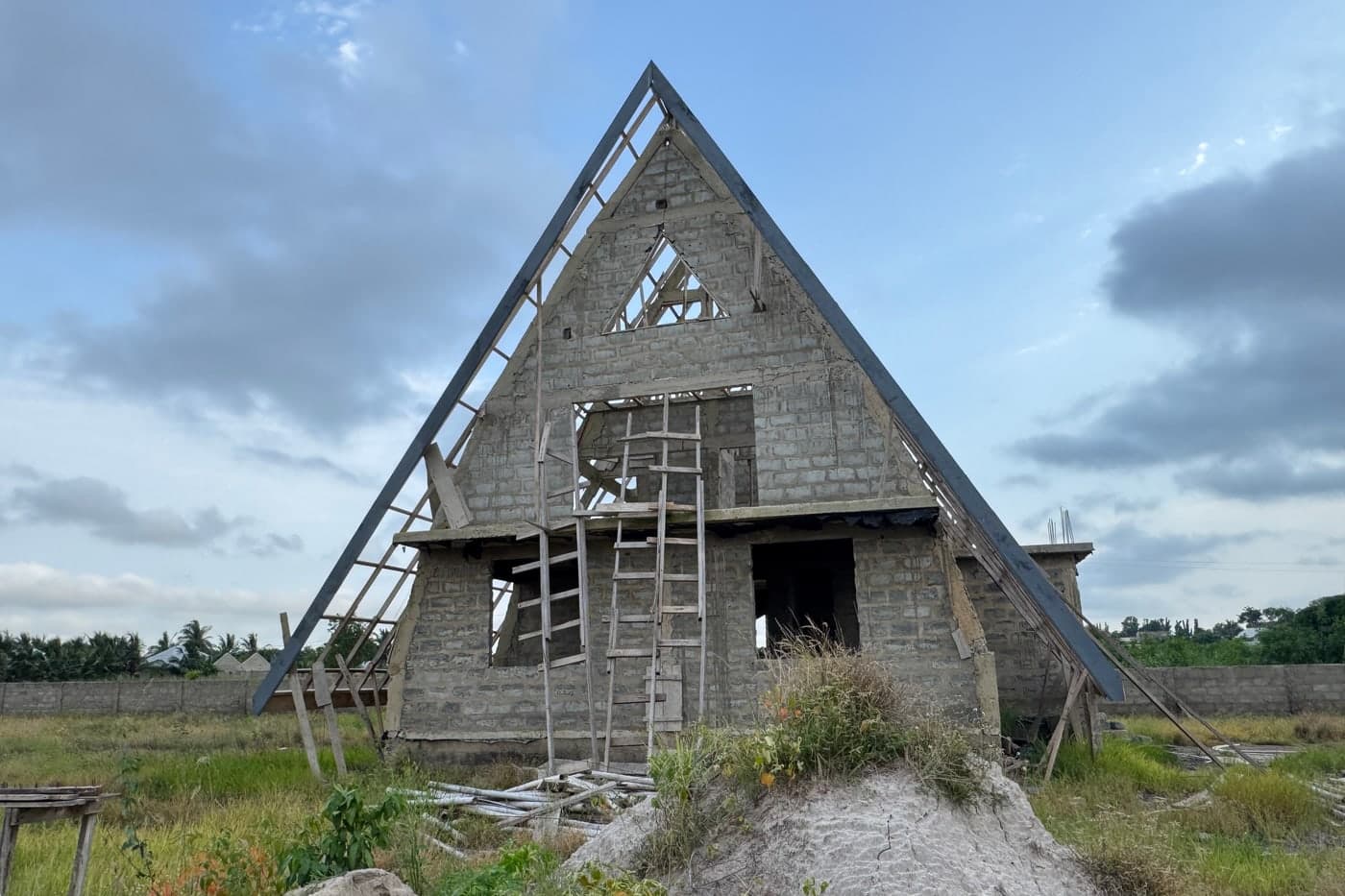
Toivo Investment. We are a principal developer, GIPC-registered since 2019, currently building an eight-unit gated estate at Akatsi, Volta Region, Ghana — three-bedroom, three-bath A-frame units on a fifty-year renewable leasehold, ground floor with a mezzanine under the roof, two gates, tennis court, and a buyer's choice of a private pool or a courtyard garden per unit. Work is around 65 per cent complete and paused for the rainy season, resuming as the ground clears.
Volta Gate Estates. A registered Ghanaian real estate development and consultancy firm which states on its own website that it has operated since 2013 and describes itself as the premier developer in the Volta Region. We have not independently verified either claim and we are reporting what the company publishes about itself.
Everyone else. The honest position is that we could not assemble a verified list of active Volta Region developers in September 2026. There is no regional register we could load. Portal inventory is thin. Several firms marketing Volta land are Accra-based agents rather than developers, which is a distinction this page has already made and which matters more here than anywhere.
If you are researching a specific firm, do the Registrar-General search yourself, ask which of their completed projects you can visit, and go and stand on one. Renders are not evidence of delivery. Finished houses with people living in them are.
What a Volta buyer should expect on price and timeline
On price, expect a lower land component and a higher logistics component than an equivalent Accra scheme. Expect specialist trades to carry a premium. And expect the 20 per cent VAT on housing construction to sit inside the number you are quoted. That charge is live in 2026 and the Ghana Real Estate Developers Association renewed its public call for it to be scrapped in August 2026, arguing it is worsening housing affordability. We break the whole build budget down in what it costs to build a house in the Volta Region.
On timeline, expect a rainy-season pause to appear in any honest schedule. A developer who promises continuous work through the Volta wet season either has not built here or is not telling you what they will actually do.
On delivery dates specifically, our position is that we do not publish one. We publish progress. That is a deliberate choice after watching what published completion dates do to trust when weather moves them.
Questions we get asked
Are there real estate developers in the Volta Region?
Yes, though the market is small and much of it trades off-portal. Ghana Property Centre listed 24 properties for sale across the whole region in September 2026, so portal counts understate activity considerably.
Is it cheaper to buy in the Volta Region than in Accra?
Land is substantially cheaper. Construction is not proportionally cheaper, because materials travel further and specialist trades are often brought in. The saving is real but it sits mostly in the land line.
Do I need a REAC licence to buy from a developer?
You do not need one. The firm selling to you needs one only if it is acting as an agent for a third party. A developer selling its own project acts as principal and is not required to hold an agency licence.
How do I verify a Ghanaian developer from abroad?
Registrar-General search, GIPC registration if funds are crossing a border, a named escrow arrangement, and someone you trust standing on a completed project. All four can be done without flying in.
What is the biggest risk on Volta land?
An unregistered allocation paper presented as title. It is common on peri-urban land and it is not curable after the money moves. Verify at the Lands Commission before, never after.
Sources and verification
Verified September 2026.
- Ghana Property Centre, Volta Region for-sale inventory, 24 listings at time of check: https://ghanapropertycentre.com/for-sale/volta-region
- Volta Gate Estates, company self-description: https://www.voltagateestates.com/about/
- Graphic Online, GREDA on the 20 per cent VAT and housing affordability, August 2026: https://www.graphic.com.gh/news/general-news/ghana-news-20-vat-worsening-housing-affordability-greda.html
- Adom Online, GREDA renews call for scrapping of 20 per cent VAT on housing: https://www.adomonline.com/greda-renews-call-for-scrapping-of-20-vat-on-housing/
We have not published a ranking, score or rating of any third-party developer on this page, and we will not.
One next step: if you want to see what a Volta Region estate build actually looks like at close range, ask us for the current site record.