
Ground Rent in Ghana 2026: Cost, Who Pays, How to Pay
Ground rent in Ghana is the annual rent on leasehold land. Who bills it, how the amount is set, how to pay it, and what arrears really cost you.
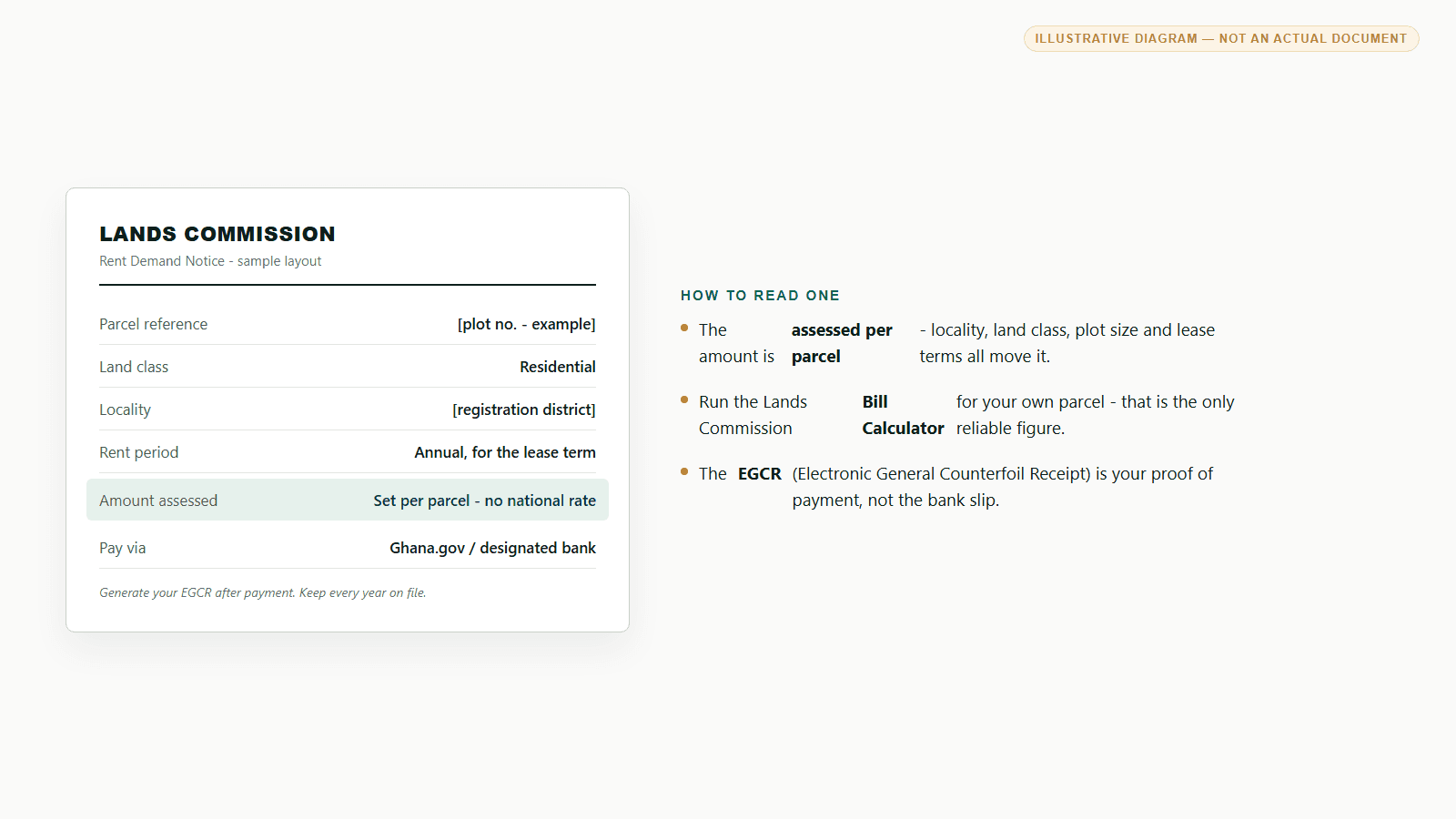
Ground rent in Ghana is the annual rent a leaseholder pays for the use of the land itself. It is not property rates and it is not a service charge. On state and vested land the Lands Commission bills it. On stool land it is collected through the Office of the Administrator of Stool Lands.
We meet this cost from both sides. We hold leases as a developer, and every few months a client rings to ask why a demand notice covering eleven years of arrears has arrived at a house they bought two years ago. The answer is almost always the same. Nobody checked the ground rent position before the money moved. Here is the whole thing, in the order you will actually meet it.
What ground rent is, and what it is not
A Ghanaian leasehold is a grant of land for a term. The lease sets out what you may build, how long you hold it, and what you pay each year for holding it. That annual payment is the ground rent. It sits in the lease itself, usually in the rent clause, and it runs for the whole term whether or not anyone sends you a bill.
Four different charges get confused with each other, and the confusion is expensive, because four different bodies issue them.
| Charge | What it pays for | Who bills it | How often |
|---|---|---|---|
| Ground rent | Use of the land under your lease | Lands Commission, or the Office of the Administrator of Stool Lands on stool land | Annually, for the term of the lease |
| Property rates | Local services such as roads, sanitation and drains | Your Metropolitan, Municipal or District Assembly | Annually, on a valuation of the building |
| Service charge | Gate, generator, water, grounds and waste inside a private estate | The estate or management company, under a private contract | Monthly or quarterly |
| Rent | Occupation of a building by a tenant | The landlord | Per the tenancy |
Ground rent is the small one. It is also the one that compounds quietly when it is missed, which is why it does more damage per cedi than anything else on that list. We set out how the four of them eat into a gross yield in the real running costs of a Ghana rental.
Who bills you depends on who owned the land first
Ghana has more than one class of landowner, and your ground rent goes to a different desk depending on which one granted your lease.
State and vested land is handled by the Lands Commission, through its Public and Vested Land Management Division. That is the division to walk into, and the one that issues the paperwork you need before you can pay anything at all.
Stool and skin land works differently. Revenue is collected under Article 267 of the 1992 Constitution by the Office of the Administrator of Stool Lands. Article 267(6) then splits it: ten per cent to the Office for administration, and of what remains, twenty-five per cent to the stool through the traditional authority, twenty per cent to the traditional authority, and fifty-five per cent to the District Assembly. Worth knowing, because it tells you that a representative asking for your ground rent in cash, personally, is not how the money is supposed to travel.
Family and private land follows whatever your indenture says. Some family grants carry a token annual rent to the grantor. Some carry none. The document governs, not the custom. We walk through the clauses page by page in what a Ghana land indenture actually contains.
How much ground rent costs, and why no honest page will quote you a figure
There is no national ground rent rate. The amount on your invoice is assessed for your particular parcel, and it moves with locality, land class — residential, commercial, industrial — plot size, the terms of your grant, and any rent review clause the lease carries.
You will find cedi tables on other sites. We checked the ones circulating in September 2026 and every figure we could trace led back to another blog post rather than to a published Lands Commission schedule. So we are not reprinting them. A wrong number here costs us nothing and costs you a budget line.
The mechanism is more useful than a table anyway. The Lands Commission runs a Bill Calculator on its online services portal, and the regional Public and Vested Land Management Division office holds the account history for your parcel. Between those two you get a real number, for a real plot, on a date.
On converting it, if your invoice reads GHS 500, that is roughly USD 44 at the Bank of Ghana interbank mid rate of 11.4000 on 4 September 2026. That is arithmetic, not a quoted fee. Use the figure on your own invoice and the rate on the day you pay.
One judgement we will make without a number, because we hold leases and have read the file: ground rent is usually the smallest recurring cost attached to a Ghanaian property. The risk it carries is out of all proportion to the amount. And the risk is not the payment. It is the lapse.
The payment flow, end to end
The sequence is fixed. Skip a step and you arrive at a bank with nothing to pay against.
- Go to the regional Lands Commission office, Public and Vested Land Management Division, with an application stating where the land is and its plot number, plus evidence of your last payment if you have one.
- Collect the Rent Demand Notice and the Ground Rent Invoice. These are the instruments that make payment possible.
- Carry ID, your phone number, a postal address and an email address. The account is registered against these.
- Pay through Ghana.gov, at a designated bank, or at the on-site bank at the regional Lands Commission office. Not to a person. Not to a facilitator who offers to sort it out for you.
- Generate your Electronic General Counterfoil Receipt on the Lands Commission online portal. The EGCR is the proof, not the bank slip.
- File the EGCR with your title documents and keep every year of them. A buyer's lawyer will ask for the most recent one.
One limit on the portal is worth knowing before you plan a trip around it. The Make Payment service covers land-related services but excludes stamp duty bills. Stamp duty is a separate errand and a separate receipt.
The Bill Calculator, and what it will not tell you
The Bill Calculator lets you estimate a Lands Commission bill before you travel. Enter the parcel details and it returns a figure. That is enough to budget against, and enough to notice when somebody at a counter quotes you something very different.
What it will not do is tell you whether the previous holder of your lease ever paid. Arrears history sits on the account at the regional office. Ask for it by plot number, in writing, and ask before you sign rather than after. Unpaid ground rent follows the land, not the person who failed to pay it.
Our habit, and we would suggest it as yours: run the calculator, screenshot the result, write the date on the screenshot. Six months later you will not remember whether the figure you are working from was current.
What arrears actually cost
In March 2026 the Lands Commission ran an enforcement drive across prime Accra, including the Airport Residential Area, and restated that ground rent is a mandatory annual obligation for all government lessees. It warned that non-compliance can attract compound interest, legal action, and in extreme cases revocation of the lease. Some properties in that exercise had more than a decade of unpaid rent, and the list included government facilities, which tells you how ordinary the neglect is.
Compound interest is the part people underestimate. A modest annual charge left alone for eleven years is no longer a modest charge, and it falls due at exactly the moment you want to sell, mortgage or renew.
Diaspora owners carry a structural version of this problem. The demand notice goes to the property, not to your inbox. If nobody is opening post at the house, the first you hear of it is when a sale stalls. Put someone in-country on the post, or ask your developer or manager to hold the account and forward you the EGCR each year.
Ground rent on a 50-year lease against a 99-year
The obligation is identical in kind. What differs is how long you carry it and what happens at the end of the term.
Under Article 266 of the 1992 Constitution a non-citizen cannot hold an interest in land for more than fifty years at a time. That is why estates built for diaspora buyers are structured as fifty-year renewable leaseholds rather than the ninety-nine years a Ghanaian citizen might hold. The tenure classes, and what renewable means once a term actually expires, are set out in our comparison of leasehold and freehold in Ghana.
It is also why our eight-unit gated estate at Akatsi, Volta Region, Ghana is structured as a fifty-year renewable leasehold, with the tenure position put in front of buyers before anything is signed. Ask any developer for the current EGCR on the parcel you are buying into. It is a reasonable request, and a developer who cannot produce one has told you something useful.
Questions we get asked
What is ground rent in Ghana?
It is the annual rent a leaseholder pays for use of the land under a lease. It is separate from property rates, which your Assembly charges on the building, and separate from any estate service charge.
How much is ground rent in Ghana?
There is no single rate. It is assessed per parcel on locality, land class, plot size and lease terms. Run the Lands Commission Bill Calculator for your parcel and confirm the account history at the regional office.
Who pays ground rent, the landlord or the tenant?
The leaseholder pays it, which in a rental situation means the landlord and not the tenant. A tenancy agreement can shift the economics between the two, but the Lands Commission holds the leaseholder liable.
How do I pay ground rent at the Lands Commission?
Collect a Rent Demand Notice and Ground Rent Invoice from the regional Public and Vested Land Management Division, pay through Ghana.gov or a designated bank, then generate your EGCR on the Lands Commission portal.
What happens if you do not pay ground rent in Ghana?
Arrears can attract compound interest and legal action, and the Lands Commission has warned that in extreme cases a lease may be revoked. Unpaid ground rent also attaches to the land, so it becomes the new owner's problem after a sale.
Is ground rent paid annually?
Yes. It runs for the whole term of the lease, in annual instalments, whether or not a demand notice reaches you in a given year.
Sources and verification
Figures and procedure verified September 2026.
- Lands Commission, Assessment and Payment of Ground Rent: https://www.lc.gov.gh/services/assessment-and-payment-of-ground-rent/
- Lands Commission online services portal, five services including the Bill Calculator, verified live 7 September 2026: https://onlineservices.lc.gov.gh/
- 1992 Constitution of Ghana, Articles 266 and 267: https://audit.gov.gh/files/publications/The_1992_Constitution_of_the_Republic_of_Ghana635603143.pdf
- Bank of Ghana daily interbank FX rates, USD/GHS mid 11.4000 on 4 September 2026: https://www.bog.gov.gh/treasury-and-the-markets/daily-interbank-fx-rates/
- Ghana Broadcasting Corporation, Lands Commission enforcement against ground rent defaulters in Accra, 20 March 2026: https://www.gbcghanaonline.com/general/land-defaulters-accra/2026/
We re-check the figures on this page monthly. If one has moved, tell us and we will correct it.
One next step: if you are buying into a Ghanaian leasehold and want the tenure and ground rent position on paper before you commit, start a conversation with Toivo Investment.